Thursday, April 16, 2009

The Parable of the Madman


Nietzsche's selection evokes great emotion. The speech of the madman, in reference to the death of God, is in itself very powerful. But I don't think he is literally referring to God being dead---I think it is much more symbolic of the notion that people were abandoning him for the potholes of sin and evil. Nietzche died right before the turn of the century, and in my opinion, his works were too soon, and too new---which therefore would make it modern. I dare say this because of Mr. Yost mentioned in class before we read: that he died before WWII and the rise of Anti-Semitism in Germany as a means of scapegoat for the rough economic times in Germany. His works were needed during this time, but he died long before he could be present in the lives of those who lived 30-40 years after his death. His lack of physical presence made it impossible for his works to make any impact on Germany during the time, because the citizens were too busy in a frenzy of chaos and depression.

In this case, the modernism found in this piece was harmful to society; not because it was too advanced for the time, but because it was needed later on. But I still think the piece is modern because of its lack of romanticism, and its stark look on reality. It is roughly comparable to the idealism of transcendentalism in America, in the sense that it was an abolishment of the establishment---but Nietzsche doesn't put any romanticism in his work.

In my other post, I said modernism doesn't use symbolism--I think I was too rash. I think in our book on page 43, this statement was in reference only to a single piece of art, something I didn't realize.

Wednesday, April 15, 2009

Modernism Novel


So we have just begun a new book to kind of rewind history to take a look at the movement pre-post-modernism--ie., modernism. On page 42 there was a great summation of the whole section. "It proclaimed itself, it exuded a confidence in its newness and radicality" And on page 43 "the figures (of modernism) are not allegorical or symbolic--their meaning must be read off the canvas, the surface of the picture". Modernism is in my opinion an attempt to redefine art as something new and original.

Also, there was talk of modernity versus modernism/modernists, which was really interesting. Modernity being referred to something as more industrial, rather than artistic.

But, it also mentioned something we discussed in class: the notion that something considered modern at its original emergence becomes an 'established tradition' (47). Something boring, old, and has-been material. Dry and boring, like what the majority of adolescents dread to read in a English fine literature course, or what they hate to have to interpret in an Art 101 course.

Thursday, April 2, 2009

Postmodernism??


Well, after reading "Introduction to Post-Modernism"--with the hyphen of course, I really learned a little bit more about the extremist views artist have on art itself. The main thing I got from this book was that art cannot be categoried. Art is collage and hybrid of a multitude of resources and traditional artistic forms. Post Modernists themselves try to break the 'art rules' and take things out of context to therefore create an artistic medium. However, the notion of a post modernist is slightly paradoxial in a sense that post-modernism is about anti-identity. And, since calling something post-modern automatically brands an image of rebellious anarchy and over-conceptualism, things considered post-modern with that title are in themselves no longer post-modern, for one cannot be in the movement if it is directly associated with it. This creates an even more complicated slant on 'What is art and who decides?'...But, an interesting one at that. I feel those who are not post-modern or who do not associate with the movement would decide the 'art' to not be art, because it is so far from mainstream

this book really on skimmed the surface on this question of art, and opened my eyes to how truly contreversal the subject is.

Friday, March 13, 2009

APPRORIATENE$$


I myself believe that in some senses, things considered 'inappropriate' such as textual pictures that deal with taboo subjects (ie. sex, religion, gory battle scenes etc) are truly appropriate in art and English courses. The purpose of these classes are to broaden our knowledge of the world in full scope, including topics that some adults deem too graphic for our innocent minds. I may not speak for everyone, but we as a whole (students that is) are not that naive---and, there is a majority of us who are mature enough to not make something 'inappropriate' become a joke. Some of these graphics help to explain the task at hand better than the written word, which can only take you so far. However, such pictures are not necessary in a math or science class, because these courses deal with arithmetic and theory, and simple/safe pictures are the best option--so as not to ruffle feathers unnecessarily...

Basically appropriateness is a judgment call, which is what makes it difficult to get a feel for in school settings. But even if that is so grey, it needs to be addressed.

Thursday, March 12, 2009

Post-Modernism


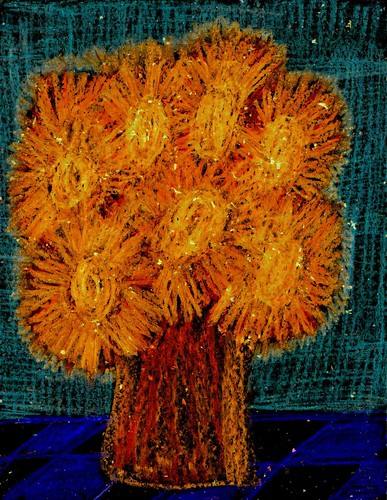
^ reproduction of Van Gogh's Sunflowers

I really was captured by the artwork on page 48. It depicted Mona Lisa saying "the more Van Gogh's 'sunflowers' becomes a poster cliche, the more you have to pay for the original!"..with a picture of a dollar bill with Van Gogh's 'sunflowers' replacing washington on the bill. I think it is quite humorous because it is a statement that is so true. Many famous pictures have been reproduced so many times that the actual piece itself becomes 'hidden' in a sea of fauxs and parodies. The more acient or distant an original piece is, the more people wish to have it for themselves, and the more money is spent at hoity-toity auctions for the rich that can afford these paintings.

Other Example:

Andy Warhol---"Marilyn Monroe"
da Vinci-----"Mona Lisa" and "Last Supper"

Wednesday, March 11, 2009

Modernism


What is modern? How can one possibly define modern? Modern is anything considered contemporary, which in itself needs another definition. Being contemporary means something to the effect of 'being in the times', but still progressive. Interior Design has a great example of modernism in real life. Clean lines, bold colors, and sometimes unclear shapes. Shapes are combined to create new shapes (a square and a circle become one (===) )

As seen in the picture above, white is a color often associated with modernism, because of the literal interpretation of 'clean lines'. The angelic qualities associated with the color white (clouds, baptismal dresses, wedding dress) white is used to show purity and polishment (and yes, I did make up the word 'polishment')

Other than that, I feel modern pieces start off modern until a new wave of modernism is defined, and the original modern work is relabeled as another type of art to make room for the new.

Tuesday, March 10, 2009

The Art Class: the students make a film

The purpose of this student created film was to show the perspective of a variety of stereotypical artists. The cliches included but were not limited to: an eager student, technically minded, overly conceptual, reluctant teacher. All are examples of fairly extreme personalities that represent most likely a small portion of the population they represent. I believe this allows the viewer to (in a humorous way) see that art has come from a multitude of cultural backgrounds and each group has left an impact on the world of art. It shows that art is not in a literal sense, but it is also not fully figurative either. It is a fascination with the blending of many styles, and each style evolved from the same source

http://www.youtube.com/watch?v=xU9je55bsxk